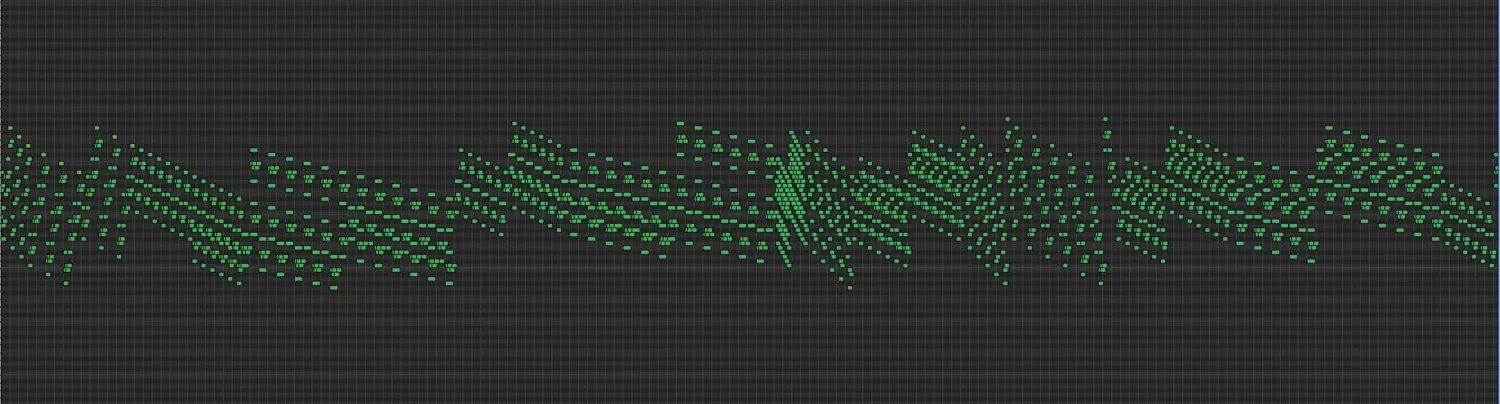
Jean Catoire stands as a unique figure in twentieth century music. Working in isolation and without recognition for most of his creative life, he has produced a prodigious number of works that can, at best, be described as minimalist. When Catoire states that he is merely the transcriber of what he ‘sees’, a listener can sense this because it is as though the composer has no personality of his own. That he has somehow tapped into another dimension of musical time and space that draws the listener into that dimension as an act of meditation. This transportation into such a deep space beyond waking consciousness is partly created by the repetitive patterns as well as the very slow tempos marked. The absoluteness and purity of purpose of the music is further enhanced by the fact that it is in no particular way idiomatic for the instruments and voices. To a great extent he need not bother indicating which instruments should be involved in a performance. If anything in music can be described as ‘archetypal’, it is Catoire’s works. Inherent in its structure is a profound sacred geometry as the music unfolds in its permutations of the basic materials. This applies to all his works in their evolution from those that are freely chromatic to those which contain only permutations of two tones.
In his programme notes for the recording entitled Extasia that he produced of Catoire’s Requiem, Op. 573 (Virgin Classics 7243 5 45324 2 9), Malcolm Bruno states: ‘Unlike most of his contemporaries, Catoire has maintained the language of triad and ritual repetition. But like the ‘thin-bodied’ sculpture of Giacometti’s late period, there is an inexplicable attrition of pace in his mature work towards a continuous, uninterrupted stillness – a stasis which remains increasingly unchallenged. Catoire’s musical thought is essentially Pythagorean; it is the laying bare of pure musical sound, in which a worldly concern for the language of words and the rhythms of speech are of no consequence. As a ‘music of the spheres’ it recognizes only the resonance and pulse of pure being perceived in sound.’
James D’Angelo,
August 2000
EssayAspects of Jean Catoire’s Music
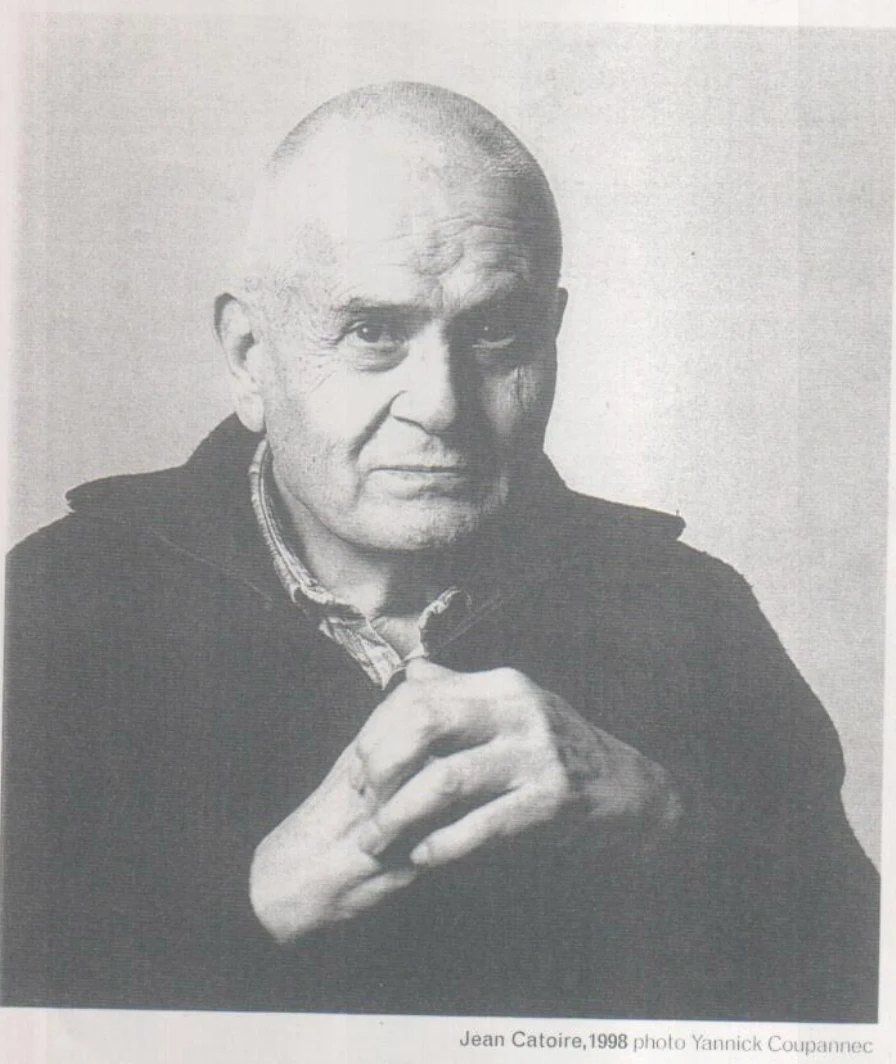
Jean Catoire is a reclusive prolific composer of a unique kind of sacred music whose full importance has yet to be recognised. Born in Paris in 1923 and nephew of the Russian composer Georges Catoire (1861-1926), Catoire was a student of Olivier Messiaen and the conductor Leon Barzin. The composer eventually rejected the aesthetics of Messiaen in favour of those of Bartok and Hindemith. From this point on he marginalised himself within the fashionable French musical circles. He found himself drawn to an altogether different sacred mysticism from Messiaen’s and between 1948 and 1955 wrote more than 30 choral religious works.
By the late 1950s his music was becoming increasingly stripped of embellishment to the point where it was anticipating the minimalist music of the late 1960s. Thus his first creative period (102 works of which 24 were destroyed) closed followed by two years of silence (1959-60). The second creative period (1961+) consists of 502 opuses for every standard instrumental and vocal combination plus works for synthesizer and Tibetan bowls. The volume is even greater when one considers that most of the works are over 30 minutes long, many lasting much longer (a few could continue up to 12 hours). Because he had to devote himself to much teaching and because of the labour and energy it took to write down what he calls his “auditive visions” (the works are seen, not heard), he had no time left to promote performances of his music. He realised too that musicians would be reluctant to play music that seemingly left no room for ordinary expressiveness.
If one had to identify his sacred phenomenon of sound world with that of an established composer, it would be the music of Arvo Part. His last days in Paris saw him doing some teaching and preparing his voluminous essays on the phenomenon of sound and other esoteric subjects for future publication. Catoire, who did not claim the title of “composer” but rather “transcriber”, has stated that his works “…were realised with the objective of revealing sound in its pure state before it has passed through the filter of musical conception.
The works are a juxtaposition of sounds characterised by a synthesis of structure and regular rhythmical values in a dynamic continuum, thereby creating elemental forms which represent the anterior, pre-sound values before their integration into any kind of musical conception or mould. This phenomenon of sound gives birth to a different sense of time and duration; it also lends to the structural elements a value and dimension beyond anything one finds in ‘music’ so-called.”
James D’Angelo
RecordingsAudio
To keep a recording, right-click the Download link (on a Mac, Ctrl-click) and choose “Save Link As…”.
-
Sextet 3 for Strings, performance by the Macedonian Radio Orchestra, conductor Christine Turrelier, 2015
-
Piano Sonata 15, op.244 performance by James D’Angelo at Colet House, West London 2015
-
Sonata 3 for 2 Trumpets and 2 Trombones, op.247 – realisation by Lawrence Ball, summer 2020
-
Organ Sonata 10, performance by James D’Angelo, at Burgh House, London, 1995
-
Sonata 4 for mixed choir a capella, op.309 – realisation by Lawrence Ball, summer 2020
-
Clarinet Sonata 3, performance by Stephen Bennett, clarinet and James D’Angelo, piano, Planet Tree Music Festival, London, 2011
-
Sonata 3 for Cello and Orchestra op 453 – performance by the Macedonian Radio Orchestra, conductor Christine Turrelier, 2015
-
Symphony 59, op.516 – performance by the Macedonian Radio Orchestra, conductor Christine Turrelier, 2016
EssayTowards a new phenomenon of sound
The visionary music and writings of Jean Catoire: by James D’Angelo
Jean Catoire never wanted to be a musician: rather music chose him to be a transcriber of unique forms of sound structures which are the antithesis of much contemporary classical music. However, Catoire did not emerge out of a musical vacuum. His uncle Georges Catoire (1861-1926) was a well-known composer in Russia, the …
Read the full essay →FilmVideo
James D’Angelo performs the full Piano Sonata 15 (42 mins) at Colet House, London August 30th, 2015 Watch on YouTube →